
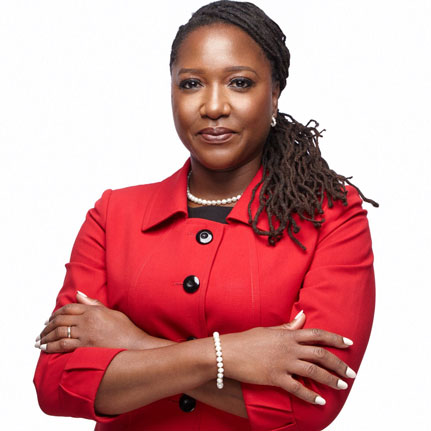
Janai Nelson is President and Director-Counsel of the NAACP Legal Defense Fund (LDF). The nation’s premier civil rights law organization fighting for racial justice and equality. LDF was founded in 1940 by legendary civil rights lawyer and the nation’s first Black Supreme Court Justice, Thurgood Marshall, and became a separate organization from the NAACP in 1957. The lawyers at the Legal Defense Fund developed and executed the legal strategy that led to the Supreme Court’s landmark decision in Brown v. Board of Education, widely regarded as the most transformative and monumental legal decision of the 20th century.
Nelson formerly served as Associate Director-Counsel and as a member of LDF’s litigation and policy teams. She has also served as interim director of LDF’s Thurgood Marshall Institute and in various other leadership capacities at LDF. Nelson was one of the lead counsel in Veasey v. Abbott (2018), a successful federal challenge to Texas’s voter ID law, and the lead architect of NUL v. Trump (2020), which sought to declare the Trump administration’s executive order banning diversity, equity and inclusion training in the workplace unconstitutional before it was later rescinded. Prior to joining LDF in June 2014, Nelson was Associate Dean for Faculty Scholarship and Associate Director of the Ronald H. Brown Center for Civil Rights and Economic Development at St. John’s University School of Law where she was also a full professor of law and served on the law school’s Senior Leadership Team.
A renowned scholar of voting rights and election law, Nelson continues to produce cutting-edge scholarship on domestic and comparative election law, race, and democratic theory. Nelson’s publication, Parsing Partisanship: An Approach to Partisan Gerrymandering and Race, appeared in NYU Law Review (October 2021), and proposes an option for the Supreme Court to address hybrid racial and partisan gerrymandering claims despite its finding that partisan gerrymandering is nonjusticiable. She also published Counting Change: Ensuring an Inclusive Census for Communities of Color, 119 Colum. L. Rev. (2019), which advances a theory of representational equality in which all U.S. residents “are to be counted — and served — as constituents” and that centers the Census and the accurate count of the country’s most vulnerable populations in the functioning of our democracy. Her other two seminal scholarly publications are The Causal Context of Disparate Vote Denial, 54 B.C. L. Rev. 579 (2013), which examines Section 2 of Voting Rights Act as a disparate impact standard and the racial dimensions of modern vote denial, and The First Amendment, Equal Protection, and Felon Disfranchisement: A New Viewpoint, 64 Fl. L. Rev. 111 (2013), which explores the intersection of the First Amendment and the equal protection clause in reconsidering the constitutionality of felon disfranchisement in the United States. Nelson has taught courses in Election Law and Political Participation, Comparative Election Law, Voting Rights, Professional Responsibility, and Constitutional Law and a seminar on Racial Equity Strategies, in addition to guest lecturing at law schools around the country. Nelson is also the recipient of the 2013 Derrick A. Bell Award from the American Association of Law Schools (AALS) Section on Minority Groups and was named one of Lawyers of Color’s 50 Under 50 minority professors making an impact in legal education.