





Legislative Updates
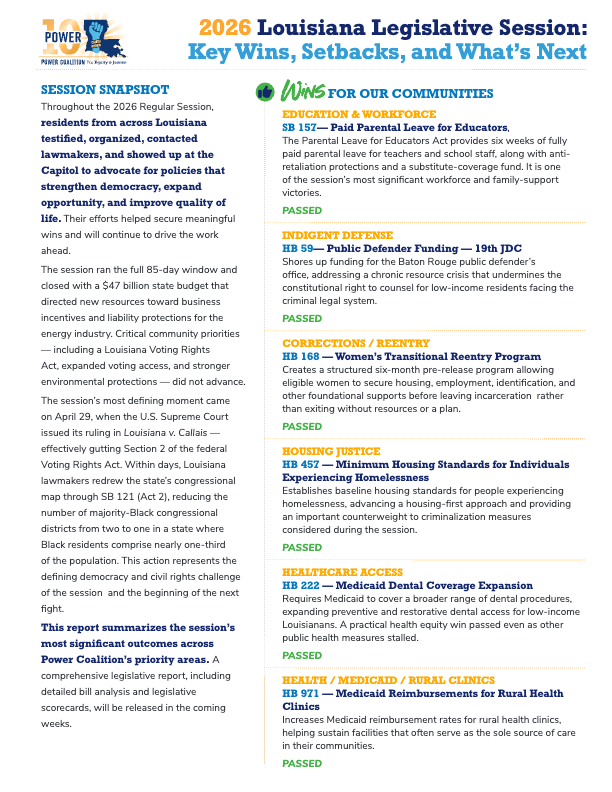
2026 Louisiana Legislative Session: Key Wins, Setbacks, and What’s Next
Session Snapshot
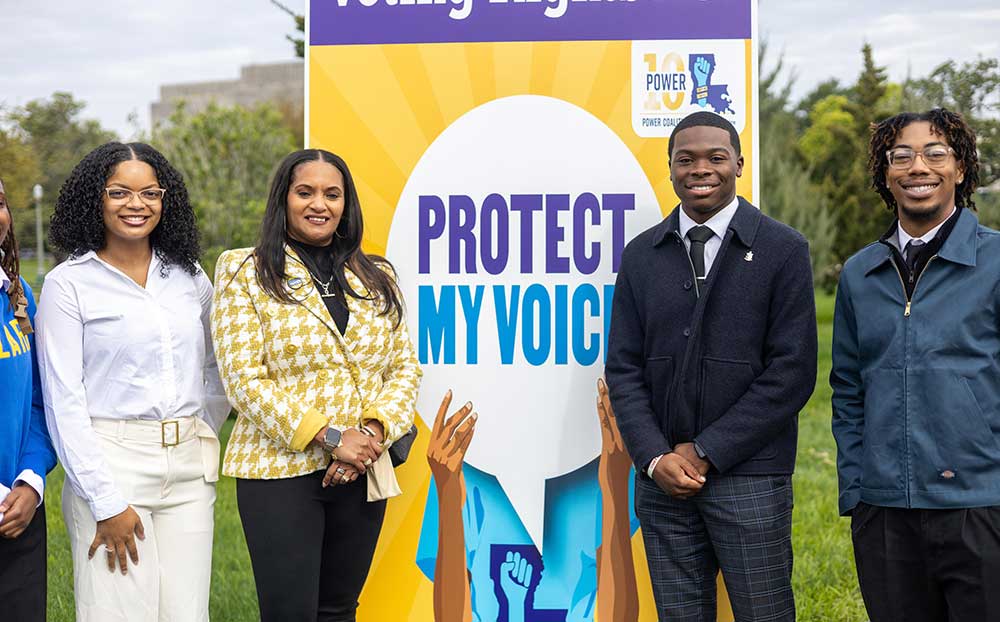
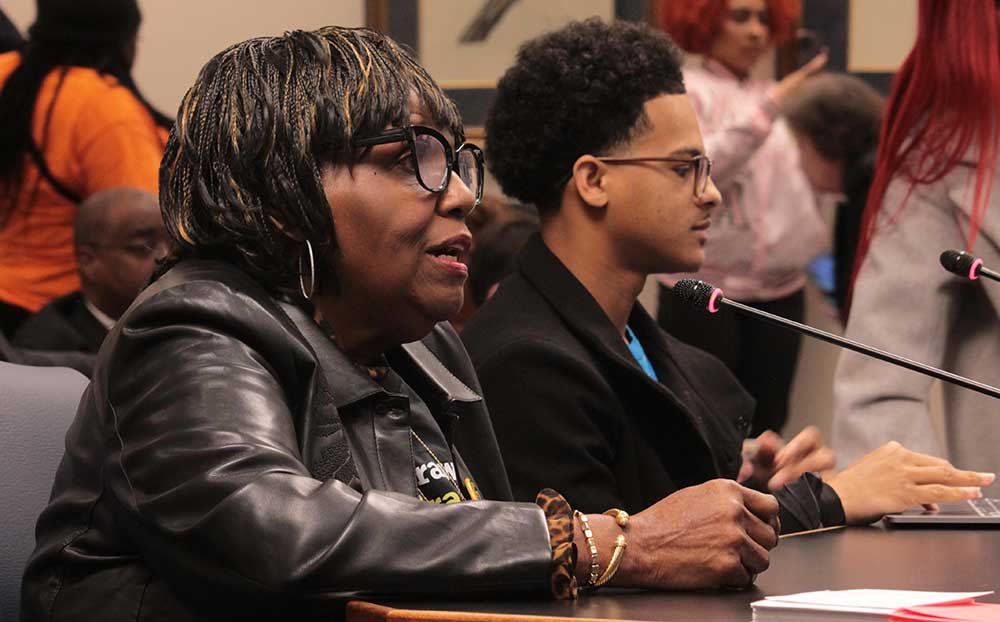
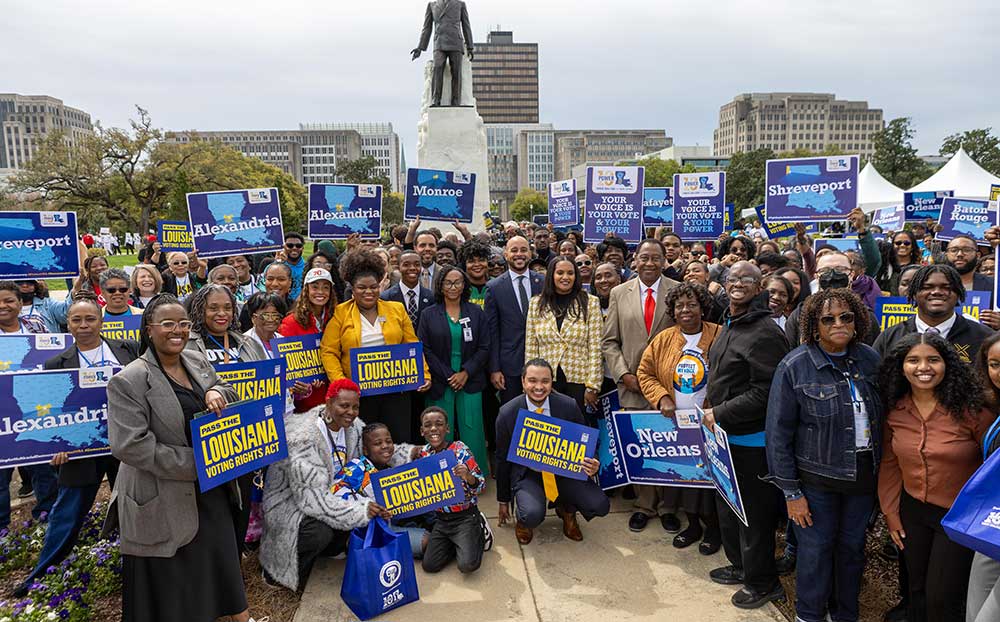
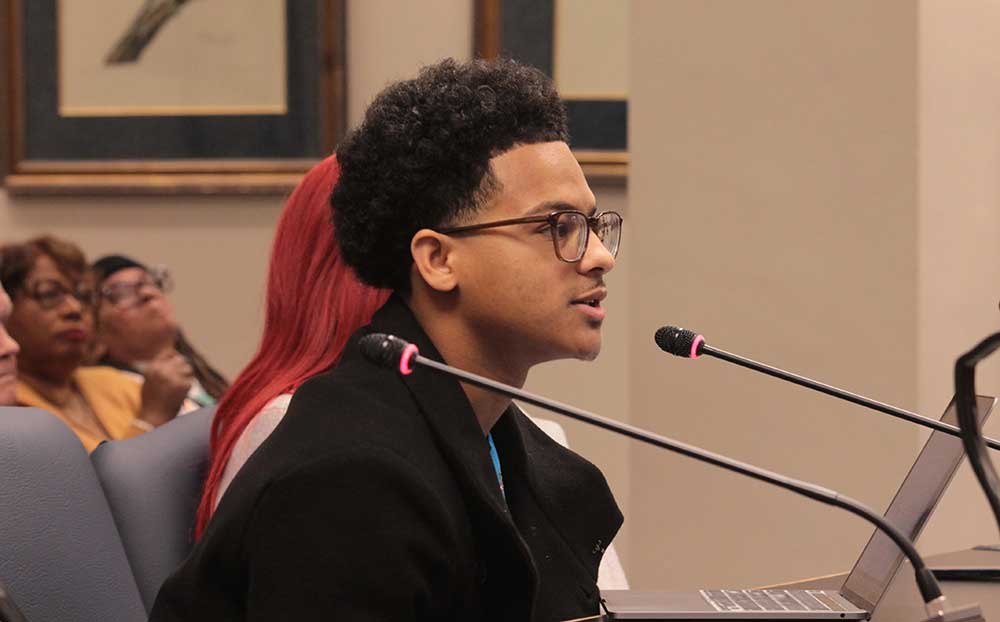
Throughout the 2026 Regular Session, residents from across Louisiana testified, organized, contacted lawmakers, and showed up at the Capitol to advocate for policies that strengthen democracy, expand opportunity, and improve quality of life. Their efforts helped secure meaningful wins and will continue to drive the work ahead.
The session ran the full 85-day window and closed with a $47 billion state budget that directed new resources toward business incentives and liability protections for the energy industry. Critical community priorities — including a Louisiana Voting Rights Act, expanded voting access, and stronger environmental protections — did not advance.
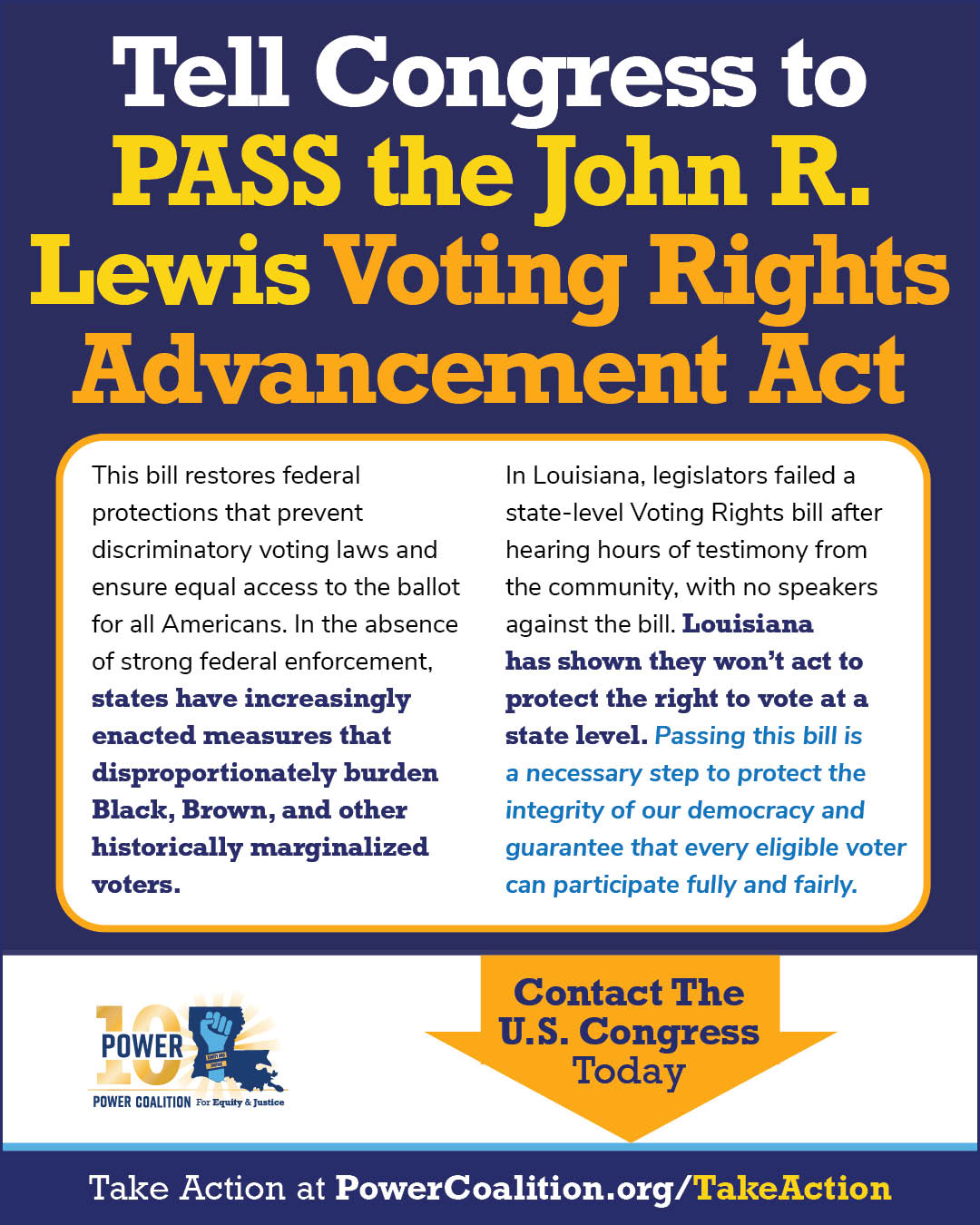
The session’s most defining moment came on April 29, when the U.S. Supreme Court issued its ruling in Louisiana v. Callais — effectively gutting Section 2 of the federal Voting Rights Act. Within days, Louisiana lawmakers redrew the state’s congressional map through SB 121 (Act 2), reducing the number of majority-Black congressional districts from two to one in a state where Black residents comprise nearly one-third of the population. This action represents the defining democracy and civil rights challenge of the session and the beginning of the next fight.
This report summarizes the session’s most significant outcomes across Power Coalition’s priority areas. A comprehensive legislative report, including detailed bill analysis and legislative scorecards, will be released in the coming weeks.
Wins for Our Communities
Education & Workforce
SB 157 — Paid Parental Leave for Educators
The Parental Leave for Educators Act provides six weeks of fully paid parental leave for teachers and school staff, along with anti-retaliation protections and a substitute-coverage fund. It is one of the session’s most significant workforce and family-support victories.
Passed
Indigent Defense
HB 59 — Public Defender Funding — 19th JDC
Shores up funding for the Baton Rouge public defender’s office, addressing a chronic resource crisis that undermines the constitutional right to counsel for low-income residents facing the criminal legal system.
Passed
Corrections / Reentry
HB 168 — Women’s Transitional Reentry Program
Creates a structured six-month pre-release program allowing eligible women to secure housing, employment, identification, and other foundational supports before leaving incarceration rather than exiting without resources or a plan.
Passed
Housing Justice
HB 457 — Minimum Housing Standards for Individuals Experiencing Homelessness
Establishes baseline housing standards for people experiencing homelessness, advancing a housing-first approach and providing an important counterweight to criminalization measures considered during the session.
Passed
Healthcare Access
HB 222 — Medicaid Dental Coverage Expansion
Requires Medicaid to cover a broader range of dental procedures, expanding preventive and restorative dental access for low-income Louisianans. A practical health equity win passed even as other public health measures stalled.
Passed
Health / Medicaid / Rural Clinics
HB 971 — Medicaid Reimbursements for Rural Health Clinics
Increases Medicaid reimbursement rates for rural health clinics, helping sustain facilities that often serve as the sole source of care in their communities.
Passed
Significant Setbacks
Voting Rights & Democracy
SB 121 — Act 2 — Congressional Redistricting
Enacted within weeks of the Callais ruling, this map reduces Louisiana’s majority-Black congressional districts from two to one, even though Black residents comprise nearly one-third of the state’s population. It is the session’s most consequential civil rights setback and will remain the subject of ongoing legal challenges, voter education efforts, and community organizing.
Passed — Act 2
HB 691 — Act 6 — Voter Citizenship Verification
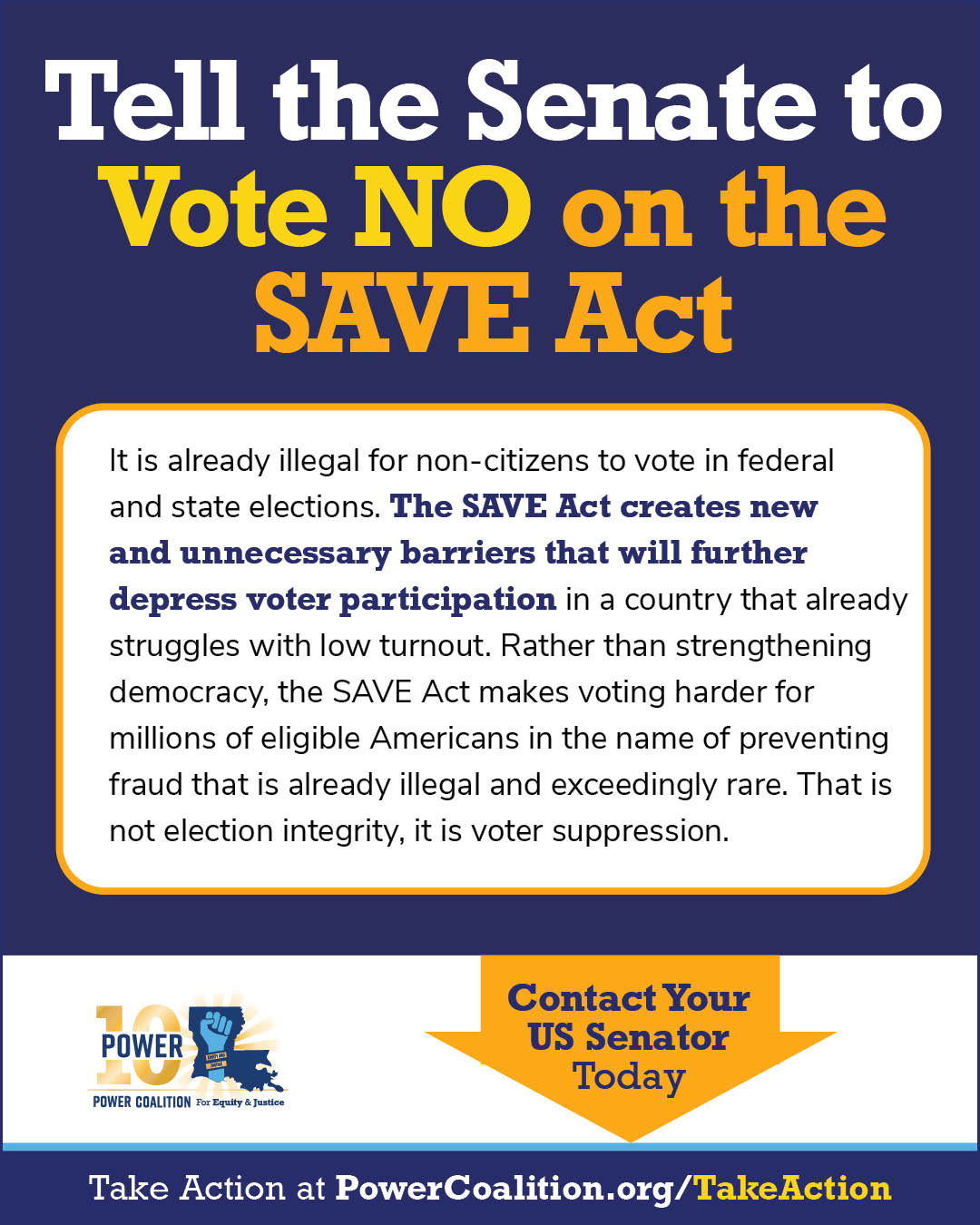
Requires the state to submit registered voters’ personal information, including Social Security numbers, through the federal SAVE database, a system originally designed to verify eligibility for public benefits rather than voter registration. Of Louisiana’s 2.9 million registered voters, only 403 individuals, or 0.01%, had previously been flagged for citizenship review. The measure could increase the risk of eligible voters being wrongly flagged and create additional barriers to voter participation.
Passed — Act 6
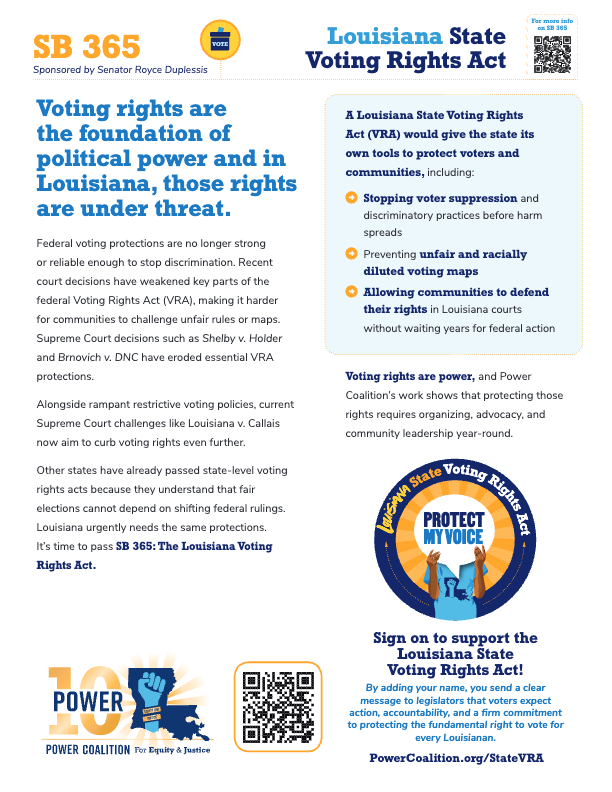
SB 365 — Louisiana Voting Rights Act
Would have established a state-level legal framework for challenging vote dilution in Louisiana courts, providing an independent remedy precisely when federal protections were being weakened. The bill died in committee and represents the session’s most significant missed opportunity for proactive democracy reform.
Died in Committee
Environmental & Climate Justice
HB 804 — Louisiana Energy Protection Act
Limits the ability of residents and communities to bring climate and environmental accountability litigation, requiring plaintiffs to identify a specific permit violation by a specific company. In a state with some of the nation’s most severe industrial pollution and coastal land loss, this measure prioritizes industry protection over environmental justice.
Passed
SB 356 — Air Monitoring for Industrial Facilities
Would have mandated air-quality monitoring systems near heavily industrialized areas, including communities in the industrial corridor disproportionately impacted by petrochemical emissions. The bill died in committee.
Died in Committee
Other Notable Setbacks
HB 209 — State Minimum Wage Increase
Louisiana has no state minimum wage and defaults to the federal floor of $7.25 per hour, unchanged since 2009. This bill sought to establish a state minimum wage. It died in committee, continuing a pattern of inaction on wage equity.
Died in Committee
HB 270 — Absentee Voting for Qualified Incarcerated Voters
Would have expanded absentee voting by mail for eligible incarcerated voters, improving ballot access for individuals who remain legally eligible to vote while incarcerated. The measure sought to reduce administrative and logistical barriers to participation and ensure that eligible voters are not effectively disenfranchised because of their incarceration status.
Died in Committee
SB 201 — Juvenile Parole Restrictions
Restricts parole opportunities for certain youth offenders and limits opportunities for release, reducing pathways to release and prioritizing longer periods of incarceration over rehabilitation.
Passed
HB 578 — “Restoring Biological Truth Act”
Writes a binary definition of sex into Louisiana statute, with downstream implications for transgender and nonbinary residents across public records, facilities, and services.
Passed
HB 211 — Homelessness Court
Establishes a new court system focused on homelessness, expanding the role of the justice system in addressing housing instability instead of greater investments in affordable housing, mental health services, and other proven solutions that address the root causes of homelessness.
Passed
SB 217 & SB 256 — Act 15 — Orleans Parish Court Consolidation
Together, these bills reduce locally elected judgeships, reorganize court governance, and transfer greater control over Orleans Parish judicial operations through a state-directed restructuring process. These changes raise concerns about local self-governance, democratic accountability, and the continued erosion of community control over institutions responsible for administering justice.
Passed — Act 15
Looking Ahead
While the 2026 Legislative Session has closed, the work continues.
In the coming weeks, Power Coalition will release a comprehensive legislative report featuring detailed bill analysis, legislative scorecards, and a deeper look at the policies that will shape Louisiana’s future.
We also recognize that understanding the session’s outcomes is only the first step. Communities deserve an opportunity to discuss what these decisions mean, ask questions, and help shape the strategies needed for the road ahead.
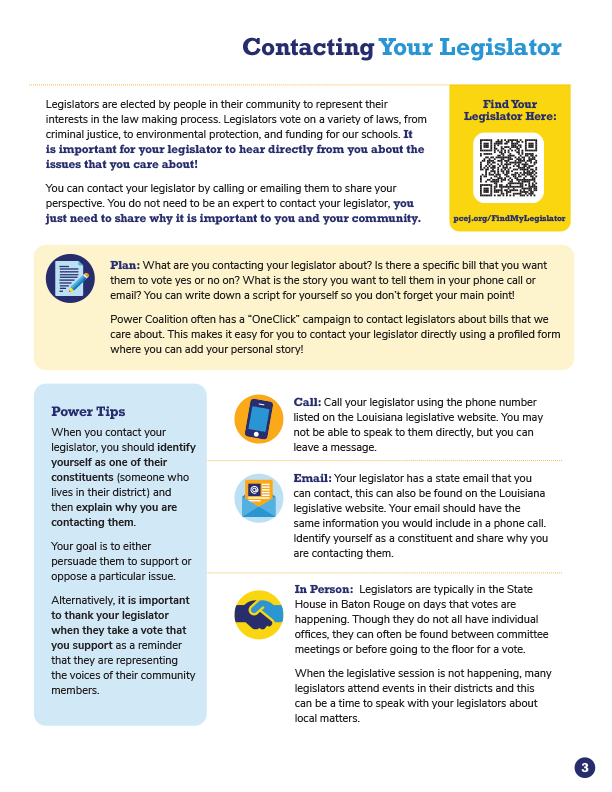
That’s why Power Coalition will partner with members of the Louisiana Legislative Black Caucus to host a statewide community listening and education tour. Together, we’ll break down the session’s major outcomes, discuss their impact on our communities, hear directly from residents, and identify opportunities for future action.
The fight for voting rights, fair representation, economic opportunity, environmental justice, and accountable government did not end when lawmakers adjourned. The next chapter begins now.
We invite community members, faith leaders, advocates, students, and local organizations to join us. Attend a stop, bring your questions, share your experiences, and help us continue building the collective power needed to meet the challenges ahead.




Legislative Resources
Know Your Rights: 2025 Louisiana Laws That Impact Everyday People
Legislative Primer
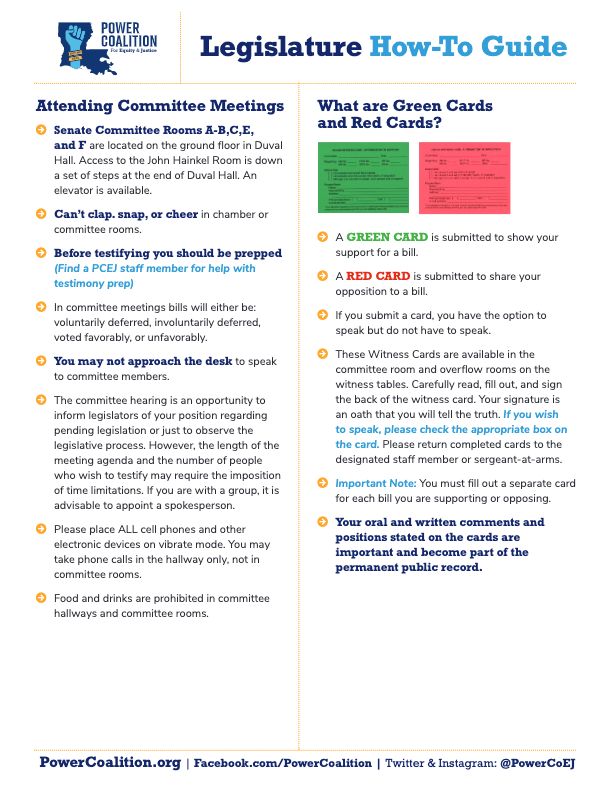
Power Testimony: Testifying at the Capitol Training